
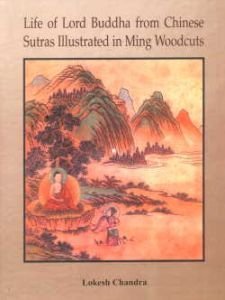
Life of Lord Buddha : Compiled by Monk Pao-ch'eng from Chinese Sutras and Illustrated in Woodcuts in the Ming Period Book
Contents: Introduction. 1. Salvation by the Buddha of the Sakyas. 2. Buddhas of the past. 3. He buys flowers and offers them to the Buddha. 4. He is reborn in the Tusita Heaven. 5. Story of Gautama Kama-Sakya. 6. King Suddhodana. 7. The dream of Maya. 8. He was born under a tree. 9. The child is taken to a garden in the city. 10. Prediction of the Ascetic Asita. 11. Amnesty and bounties. 12. The child is brought up by his maternal aunt. 13. Presentation of the child at the Temple of the Gods. 14. Sports in the park. 15. Study at school. 16. Study of military arts and of practical sciences. 17. Coronation of the prince. 18. He contemplates on the working of Farmers. 19a. Athletic competition. 19b. Episode of the elephant. 20. Marriage of Siddhartha. 21. Life in pleasures. 22. Voice in the sky. 23. The dream of King Suddodhana. 24. Meeting an old man. 25. Meeting a sick man. 26. Meeting a corpse. 27. Meeting a monk. 28. Dreams of Yasodhara. 29. He announces that he is going to depart. 30. Evasion at midnight. 31. He cuts his hair. 32. He is separated from Channa. 33. Channa returns to the palace. 34. Siddhartha consults the Rsis of the forest. 35. Invitation to return. 36. He meets the two rsi's at a loss. 37. Six years of austerities. 38. The father sends him provisions. 39. Two cowherdesses give him milk. 40. Bath in the Nairanjana River. 41. Devas and Nagas wait upon him. 42. He sits at the foot of the tree. 43. Indra provides him grass. 44. A Nagaraja praises him. 45. Under the tree. 46. Dreams of Mara….
"This Life of Lord Buddha is a reproduction of the Shih-chia ju-lai ying-hua shih-chi, a collection of important episodes in the life of Lord Buddha, cited from different Sutras translated into Chinese from the 3rd to the 13th century. The citations are illustrated on opposite pages, so that the pious could visualise the Dharma of the Tathagata. They are 'Visual Dharma'. The Chinese has been translated into English. It was compiled by Monk Pao-ch'eng during the Ming period. It was revised by Prince Yung-shan the grand nephew of Emperor K'ang-hsi. He had new woodcuts done in 1787-93. The landscape, buildings, persons, city layouts, gardens, etc. are styled as was done in the 18th century. The simple lines, athirst for the beauty of the beyond, were to deepen the spiritual tone. A Chinese proverb says: 'a picture is a voiceless poem, a poem is a vocal picture'. The hieratic art of this volume is an evocation of the Chinese proverb in its powerful lines and in its tranquil Sunyata of minimal art. It has been translated into English for the first time. It is of interest to scholars of Buddhist art, thought, social life, and hagiography." (jacket)