
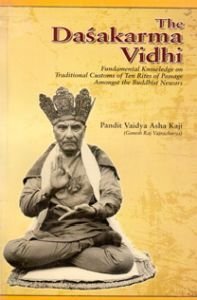
The Dasakarma Vidhi: Fundamental Knowledge on Traditional Customs of Ten Rites of Passage Amongst the Buddhist Newars Book
The dasakarma vidhi ten rites of passage are performed in two different ways, namely jnana sambhara and karma sambhara. The former refers to the prerequisites of spiritual knowledge, whereas the latter refers to the prerequisites of action. Even the Buddha is said to have spiritually performed the dasakarma before he attained Buddhahood. It is said amongst the Buddhist Newars of the Kathmandu valley and elsewhere that one cannot achieve enlightenment without performing the dasakarma, either spiritually or ritually. The dasakarma begin with the birth ceremony jatabhiseka and end in the ceremonial initiation of the Supreme Seniormost or Head of the Community cakresvarabhiseka. The system of the dasakarma is so instilled in the life of every Buddhist Newar that the rites have become part and parcel of the life-cycle, thus presenting as inseparable traditional and cultural rites unique among human beings on earth.
The practices of dasakarma were initially performed by King Pracanda Deva of Gaud India, who is said to have come to Nepal on a pilgrimage to pay homage to Svayambhu. This king, being highly inspired by the supreme serenity and spiritual tranquility of the Svayambhu jyoti rupa the rays radiating from Svayambhu made up his mind to renounce his kingship and sought ordination of cudakarmabhiseka first initiation of entry into the life of homelessness, subsequently followed by acaryabhiseka initiation into priestly life bestowed on him by Manjusri. By thus performing the dasakarma vidhi he became the first Vajracarya, who was later known as Santikaracarya, the father of all Vajracaryas in the past and the present.