
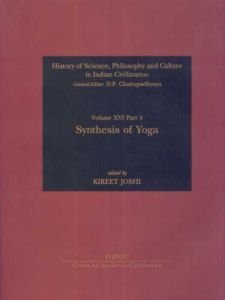
History of Science Philosophy and Culture in Indian Civilization : Vol. XVI. Yoga (CONSSAVY) : Part IV. Synthesis of Yoga Book
Contents: Preface/Kireet Joshi. General introduction/D.P. Chattopadhyaya. Editors. Contributors. Introduction/Kireet Joshi. Synthesis of Yoga: Prefatory remarks/D.P. Chattopadhyaya. 1. Earliest records of synthesis of Yoga/Kireet Joshi. 2. Synthetic origin of Yoga in the Veda/S.P. Singh. 3. Synthesis of Yoga in the Upanisads/N. Jayashanmugam. 4. The Gita and its synthesis of Yoga/Kireet Joshi. 5. The synthesis of Yoga in Buddhism/Wangchuk Dorjee Negi. 6. A synthesis of faith, knowledge and conduct: the Jain perspective of synthetic Yoga/Dayanand Bhargava. 7. Patanjali’s Yoga — a synthesis/Rama Jain. 8. Taoism as a paradigm of the synthesis of Yoga/S. Shyam Kishore Singh. 9. Synthesis of Yoga in Saiva Siddhanta/S. Ram Mohan. 10. Synthetic of Yoga in Tantra with special reference to the Siddhas/T.N. Ganapathy. 11. Synthesis of Yoga in the Puranas (with special reference to Astanga-Yoga)/Gangadhar Panda. 12. Synthesis of Yoga in Srimad Bhagavata/G.C. Nayak. 13. Synthesis of Yoga in the Tantric (Saiva-Sakta) tradition/Kamalakar Mishra. 14. Synthesis of different Yogas in Jain Tantricism/Sagarmal Jain. 15. Synthesis of Yoga in Vedantic systems/R. Balasubramanian. 16. Synthesis of Yoga in Vaisnavism of Ramanuja/S.M.S. Chari. 17. Synthesis of Yoga in the Bakti Movement/Prema Nandakumar. 18. Synthesis of Yoga in Lingayatism/N.G. Mahadevappa. 19. Multiplex concepts of Yoga: As per the philosophical framework of Vallabha Vedanta Shyam Manohar Goswami (Translated from original Hindi into English by Achyutananda Dash). 20. Yoga of synthesis in Kashmir Saivism/S.S. Toshkhani. 21. Guru Nanak on Yoga in the medieval period/Jodh Singh. 22. Synthesis of Yoga in the philosophy of Caitanya Mahaprabhu/Satya Narayan Das. 23. Synthesis of Yoga in the teachings of the Baha’i Faith/A.K. Merchant. 24. Synthesis of Yoga in Sri Ramakrishna and Swami Vivekananda/Godabarisha Mishra. 25. Synthesis of Yoga in Akhanda Mahayoga/S.I. Tripathi. 26. Our need of a new synthesis of Yoga (A journey to the theme of manifestation of supramental consciousness in matter)/Kireet Joshi. 27. Yoga and knowledge/Aparna Banerjee. 28. Sapta Chatusthaya: Sri Aurobindo’s agenda for Yoga/A.K. Sen Gupta. 29. Mother’s agenda (an introductory essay)/Jyoti Madhok. 30. Satprem and evolution II in synthesis of Yoga/Kireet Joshi. Index.
The volumes of the Project on the History of Science, Philosophy and Culture in Indian Civilization aim at discovering the main aspects of India’s heritage and present them in an interrelated way. These volumes, in spite of their unitary look, recognise the difference between the areas of material civilization and those of ideational culture. The project is not being executed by a single group of thinkers and writers who are methodologically uniform or ideologically identical in their commitments. In fact contributions are made by different scholars with different ideological persuasions and methodological approaches. The project is marked by what may be called ‘methodological pluralism’. Inspite of its primarily historical character, this project, both in its conceptualization and execution, has been shaped by scholars drawn from different disciplines. It is for the first time that an endeavour of such a unique and comprehensive character has been undertaken to study critically a major world civilization.
This history of Indian Yoga is almost fascinating chapter in the larger history of man’s highest endeavours to exceed manhood and to hew new paths of evolving the next species. This volume concentrates on the them of the synthesis of Yoga, and dwells principally on five systems of the synthesis of Yoga: the very first synthesis of Yoga is to be found in the Vedic Samhitas — the earliest records of human civilization. This synthesis was followed by the synthesis that we find in the Upanisads. The yoga of the Gita, which comes next, is eminently the synthesis of the paths of knowledge, action and devotion. The fourth synthesis is to be found in the Tantra. The latest synthesis of Yoga which draws from all previous systems of Yoga, presents a new departure both ion its objectives and methods. This is the synthesis of Yoga of Sri Aurobindo and the Mother, which has worked out, with scientific rigour the processes of ascent to the super mind as also of the descent of the Supermind on the Earth, — the processes that are new and indispensable for the synthesis of matter and spirit and for the evolution of the Supramental Divine Body, which will mark a revolutionary change in the very processes of evolution and establish a new mode of supramental action capable of crating on the earth the fulfillment of the ideals of light, freedom, bliss and immortality. Science and spirituality meet in a natural synthesis in this Yoga and it provides a solution to the contemporary evolutionary crisis. It is this theme that imparts to this volume its special relevance.
This volume, while laying due emphasis on the above mentioned five systems of synthesis, brings out subtleties and complexities of various other systems of Yoga in an attempt to show how the tendency of synthesis is vividly present in them. In some respects, this volume revisits some of the areas that have been expanded in great detail in the earlier volumes on Yoga that form part of PHISPC.
Pursuit of Yoga is a living tradition in India, and it is this pursuit which provides to Indian culture its perennial spiritual essence. This volume while dwelling on the theme of the synthesis of Yoga takes us to those realms of spiritual consciousness by the cultivation of which humanity can arrive at the art and science of collective practice of spiritual fraternity that is indispensable for everlasting peace and harmony on the earth.
Yoga is the greatest gift that India can present to the world and in this context, readers will, it is appreciate the value of this volume.