
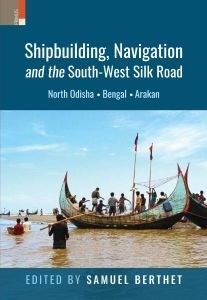
Shipbuilding, Navigation and the South-West Silk Road: North Odisha, Bengal and Arakan Book
Contents: Preface. Introduction: Chittagong and the Northern Bay of Bengal: Shipbuilding, Circulation and Spaces/Samuel Berthet. Part I: Chittagong and the Northern Bay of Bengal in the Early Historical Period. 1. Ancient Maritimes Routes and the Bay of Bengal/Jean-François Salles. 2. Vangam, the Eastern Sea and Maritime Interactions in the Bay of Bengal Region/V. Selvakumar. 3. Harikela (Chittagong) and its Sphere of Interaction/Suchandra Ghosh. 4. A Bridge over Troubled Waters: Portuguese Chittagong in Early Modern Times/Radhika Chadha. 5. Goods and Trade in Chittagong and Bengal in 1607 as Depicted by Pyrard de Laval/François Pyrard De Laval. Part II: Shipbuilding Culture and Technology in Chittagong and the Northern Bay of Bengal. 6. Moving Technology: Shipbuilding in the Northern Bay of Bengal/Samuel Berthet. 7. Shipbuilding at Chittagong, Fifteenth to Nineteenth Centuries/Michael W. Charney. 8. A Note on the Port of Chittagong during the Ming Voyages/Sally K. Church. 9. Shipbuilding Technology and Navigational Practices of Chittagong Mariners/Shahnaj Husne Jahan. 10. A Contemporary Survey of ‘Country’ River Boats in West Bengal/Swarup Bhattacharyya and Abhijit Das. Index.
Shipbuilding, Navigation and the South-West Silk Road: North Odisha, Bengal and Arakan looks at circulation and ships in a space that brings together the Indian subcontinent, the Himalayan regions, south-west China and South-East Asia, connecting those regions to the larger Indian Oceanic trade. This space is organized around the Ganga-Brahmaputra-Meghna delta, a constantly moving topography criss-crossed by hundreds of changing rivers, where boats and ships play a pivotal role in circulation, trade and wealth. So far, boats and ships of the Northern Bay of Bengal have been the subject of very few studies. Shallow draft vessels, able to navigate the coast, estuaries and deep rivers provided the technological response to a particular typography. They are also the reflections of a form of transportation that evades the control of a central and land-based polity. Their understanding is crucial to reassess our idea of roads as well as the history of technology and trade in a space central to circulation, yet highly politically fragmented and evading sustainable control. The study of shipbuilding highlights the relevance of technological features shared beyond area studies and periodization. Thanks to a cross-discipline, cross-area and cross-era approach, the book offers a water-centric perspective on the region.